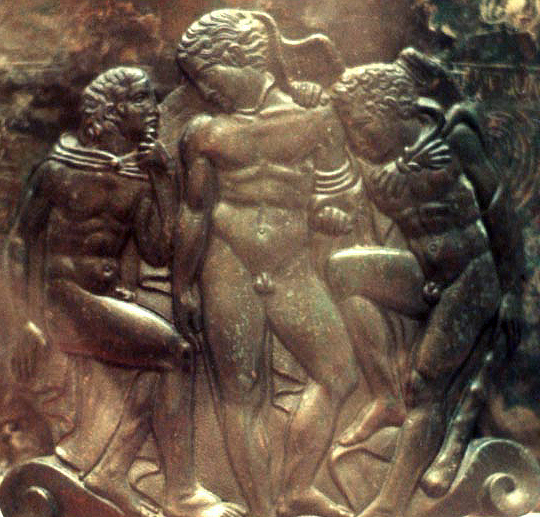
Iolaus, son of Iphicles and so nephew of Heracles, was the hero's faithful charioteer and companion, who shared with him most of his labours.1
He was born to Iphicles, the mortal twin of Heracles, by Automedusa, daughter of Alcathous; when Creon later gave Iphicles his younger daughter, Iolaus was already his son. So the boy stood one generation down from the Perseid line and one step aside from his uncle Heracles — kin by blood and bound to him by service.2
The earliest song of Iolaus is of the Hydra. Hera had reared the serpent of Lerna out of measureless anger against mighty Heracles, and it was Heracles, son of Zeus of the house of Amphitryon, together with warlike Iolaus, who destroyed her with the pitiless bronze through the counsels of Athena.3
Apollodorus fills in the work of his hands. Heracles came to Lerna mounting a chariot driven by Iolaus, and drove the nine-headed thing from its den beside the springs of Amymone with burning shafts. As his uncle crushed the heads and the immortal middle one was struck off, Iolaus took up firebrands and seared the roots of the severed necks, so that no new heads could sprout — and the labour was won by the two of them together.4
After the labours, in the telling Apollodorus follows, Heracles went to Thebes and gave Megara to Iolaus before seeking a new bride for himself — a tradition that lets the first wife pass to the loyal nephew rather than be kept by Heracles.5
In a later age Iolaus led the earliest of the Athenian colonial expeditions: Iolaus of Thebes, nephew of Heracles, brought Athenians and Thespians across to Sardinia. The Thebans kept his memory at home — before the Proetidian gate stood his gymnasium and a hero-shrine — yet they themselves admitted that Iolaus died on Sardinia among the very settlers who had crossed with him.6
⁂
the spine ignites as you read · hover a bond on the card — every mention of them lights in the story