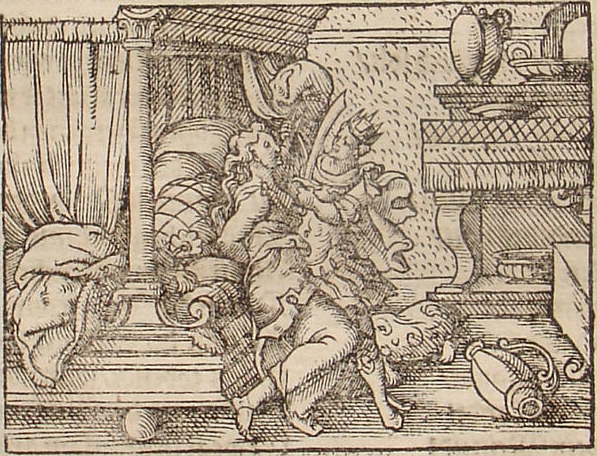
A Thracian king, son of Ares, summoned by Pandion of Athens to help in his border war with Labdacus and rewarded with the hand of Pandion's daughter Procne, by whom he had a son, Itys. Falling in love with her sister Philomela, he seduced her and cut out her tongue, and was punished when Procne killed Itys and served him to his unwitting father at supper.1
Apollodorus sets him at the edge of the Athenian house. Pandion, married to Zeuxippe, begat the daughters Procne and Philomela and twin sons, Erechtheus and Butes; and when war broke out with Labdacus over a boundary, he called in Tereus, son of Ares, from Thrace. Their joined arms brought the war to a successful close, and in payment Pandion gave Tereus his own daughter Procne in marriage. By her Tereus had a son, Itys.2
The marriage was the seed of the horror. Falling in love with Philomela, Tereus seduced her also, saying that Procne was dead, for he had concealed his wife in the country; then he cut out Philomela's tongue so she could not accuse him. But by weaving the characters into a robe she revealed her sorrows to Procne. Having sought out her sister, Procne killed her own son Itys, boiled him, and served him up for supper to the unwitting Tereus, then fled with Philomela. When Tereus learned what had been done, he snatched up an axe and pursued them; overtaken at Daulia in Phocis, all three prayed to be turned into birds, and Procne became a nightingale, Philomela a swallow, and Tereus a hoopoe.3
Hyginus tells the same crime with the roles of the sisters reversed. While married to Procne, daughter of Pandion, Tereus, son of Mars, came to Athens claiming Procne had died and asked Pandion for Philomela; the father consented and sent her with guards. On the way Tereus threw the guards into the sea, ravished Philomela, and cut out her tongue; betrayed at last by the woven robe and the murdered Itys, he pursued the fleeing sisters until, by the pity of the gods, Procne was changed into a swallow and Philomela into a nightingale, while Tereus, they say, was made a hawk.4
In his catalogues Hyginus fixes the family among the damned. Among mothers who killed their sons he names Procne, daughter of Pandion, who killed Itys, her son by Tereus; and among those who ate the flesh of their children at banquets he names Tereus, son of Mars, his son Itys by Procne.5
Ovid unfolds the whole Thracian saga at length. Boasting descent from mighty Gradivus, Tereus came to the relief of besieged Athens, won glory in arms, and was bound to Pandion by marriage to Procne, a wedding the Furies, not Juno or Hymen, attended. When Procne longed to see her sister, Tereus sailed to fetch Philomela, and the sight of her kindled a barbarous lust; carrying her off, he raped her in a hut deep in the forest, then shore away her tongue when she threatened to publish his guilt. A year imprisoned, she wove the truth into a web; Procne, freeing her under cover of Bacchic rites, took her revenge in the murdered Itys, whose flesh she set before his father, crying out the deed at the climax. As Tereus rose with his sword, the gods turned the three to birds, and the king became a crested hoopoe.6
Pausanias localizes the king and reads the moral in the landscape. By his grave near Megara the Megarians claimed he had ruled around the Springs (Pagae) of Megaris, but Pausanias judges from the evidence that he reigned over Daulis beyond Chaeronea. Unable to seize the fleeing women, Tereus killed himself; the Megarians raised him a barrow, and there, they say, the hoopoe first appeared. At Daulis the women served Tereus his own son, which act was the first pollution of the dining-table among men; into a hoopoe, a little larger than a quail, the legend says he was changed. Harmonia herself, Pausanias adds, was held to have known of crimes like the Thracian's.7
⁂
the spine ignites as you read · hover a bond on the card — every mention of them lights in the story