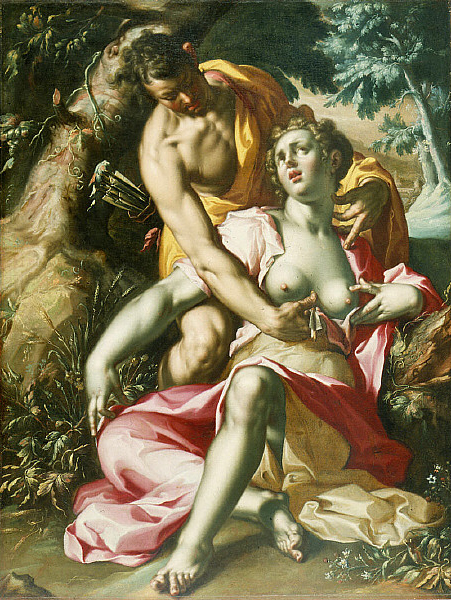
An Athenian princess given in marriage to Cephalus, son of Deion of the Aeolid house; after their love was broken and mended, Cephalus killed her by accident while hunting, mistaking her in the thicket for game.1
Her father is disputed even among those who agree on her end. Apollodorus makes Procris a daughter of Erechtheus by Praxithea, sister of Creusa, Chthonia, and that Orithyia whom Boreas carried off, and gives her in marriage to Cephalus, son of Deion; Pausanias likewise calls her "Procris the daughter of Erechtheus." Hyginus instead names her the daughter of Pandion. Whichever king begot her, all bind her to Cephalus the Phocian, son of Deion of the Aeolid line.2
Apollodorus tells the marriage as a chain of betrayals. Bribed by a golden crown, Procris admitted Pteleon to her bed, and being detected by Cephalus she fled to Minos. Minos desired her, but his wife Pasiphae had bewitched him so that he loosed wild beasts upon any woman he lay with; Procris first gave him the Circaean root to drink that he might come to no harm, and in return for sharing his bed received from him a swift dog and a dart that flew straight and never missed. Then, fearing Minos's wife, she came to Athens, was reconciled to Cephalus, and went out hunting with him, for she was fond of the chase — and as she pursued game in the thicket Cephalus, not seeing her, threw the dart, struck her, and killed her, for which he was condemned in the Areopagus to perpetual banishment.3
Ovid keeps the death but recasts its cause as innocent grief. Cephalus and Procris loved each other and swore never to be untrue; Cephalus, weary from hunting, would call upon the breeze — "Aura, come" — to cool him, and a meddling listener carried the name to Procris as the name of a rival. Stricken, she followed him into the woods to catch him out; when he heard a rustling among the leaves and hurled his unfailing javelin at what he took for a beast, he pierced his own wife, who died in his arms knowing at last that there had been no Aura but the wind.4
Hyginus tells the breach differently. In his Fabulae, Aurora, spurned by the faithful Cephalus, disguised him as a stranger to test Procris; deceived in turn, Procris fled to Crete, where Diana gave her a javelin none could escape and the hound Laelaps no beast could outrun, and sent her back to outhunt and so win back her husband. Reconciled yet fearful, she stole after him at dawn to watch him; when the bushes stirred Cephalus hurled the unavoidable javelin and killed her unwittingly — and Hyginus lists him among the men who slew their own wives. In his star-lore he gives the hound another origin: once Jove's guardian of Europa and later Minos's, it came to Procris as her reward for curing the sick Minos, and after her death passed to her husband Cephalus.5
Her hound outlived her and ran into another legend. Apollodorus says that when a monstrous vixen was ravaging the land of Thebes, Amphitryon obtained from Cephalus, in return for a share of the Teleboan spoils, the dog Procris had brought from Crete as a gift from Minos, which was fated to catch whatever it pursued; set against a fox fated never to be caught, the contradiction was insoluble, and Zeus turned both dog and fox to stone. Pausanias tells the same petrifaction at Teumessus, but names the hound as the one Artemis had given to "Procris the daughter of Erechtheus."6
⁂
the spine ignites as you read · hover a bond on the card — every mention of them lights in the story